
Ships come and go like the tides. Today they lie proudly in the harbour, tomorrow they are a mere spot on the horizon. Owners and names change. Bows are sanded down and the past deleted with a fresh coat of paint. The sea does not remember names. The waves delete every trace without effort. Wherever a ship manoeuvres the waves majestically for a few moments, the sea only shows blue water without a trace of what had been. But, God never forgets. He remembers every ship, every trip and every meeting that He arranged.
The KILIMANI is just such a ship. She has been anchored in the harbour since 2017, at first with another name and now, finally back wearing a new coat. She is freshly painted and repaired as if it is a new beginning. But, it is on board where the biggest change took place...
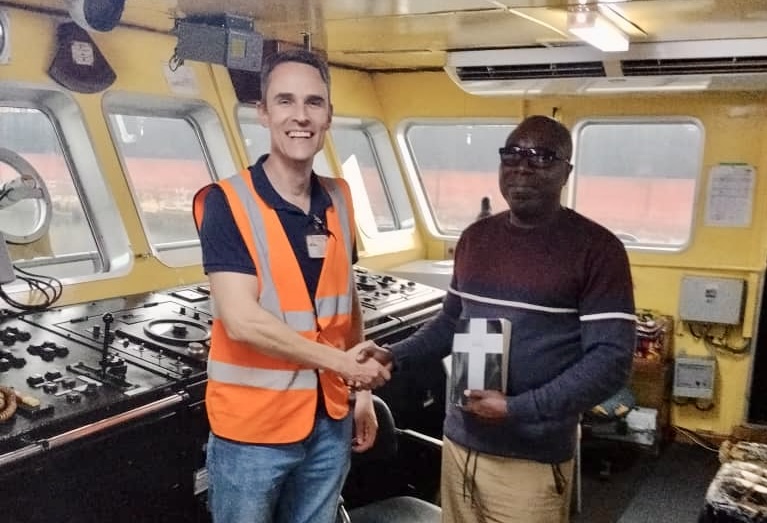
A new crew from Nigeria moved in. Chris barely stepped on deck when they asked unexpectedly: "Do you perhaps have Bibles for us?" Chris has two Bibles in his backpack and when he takes them out, the smiles are broad. They eager way in which they are accepted, tells a story of its own.
How often does it still happen that people hunger so for God's Word? The men come from a country where faith often comes at a price. There Christians live, in some parts, with violence and prosecution as an essential part of their choice for the Man on the Cross. Perhaps because of that the Bibles they are holding now are so dear to them. It is light. It is hope. It is life.
The Captain appears. When their eyes meet, Chris realises that they have met before. Then something happens that no statistics could ever explain...
The Captain turns on his heel and walks away, before returning with a Bible in his hand. He shows it with silent pride. The pages are no longer crisp and white, they are soft and pliable from use, some folded back to mark beloved passages, others darkened from hands that opened them again and again. The cover bears scars of years at sea - salt, sun and storms - but also serves as a silent witness of a Bible that had been read, protected and lived with.
It is the same Bible that Chris gave him, many, many years ago in Durban! It is a gift that was handed to him many years ago in a harbour, but it is still travelling with him over the oceans.
It is easy to wonder whether a single visit, a short talk or one Bible could ever really make a difference. But, God's work is seldom measured in moments. It works over years and much travelling. He works through people that open His Word again and again when no one else is watching.
The CSO does not have an Evangelist in Nigeria. Yet, the Word reaches Nigeria every time a man working at sea returns home with a Bible in his bag and Christ in his heart. Ships become missionaries. Harbours become missionary areas. The sea that divides continents, becomes a road for God's Word to travel. A Bible given with love, seldom ends up where it had been received.
That Bible, the one that travelled more than ten years over the oceans of the world, was bought with money donated by a donor. Don't you want to become part of our work among the men working at sea? Don't you want to support us financially to achieve just that? A Bible could change a life today, tomorrow, the day after or years from now.

A chill wind sweeps cold through the Cape Town Harbour. Ropes moan against the quay, gulls glide high above and the sea butts perpetually against the steel hull of the VELOS FORTUNA. Passers-by see only another ship that has come and will go, but for the CSO each ship is a floating world full of stories of hope, longing, sacrifice, love, worry and faith. Each ship matters. Every man working at sea matters...
André, our Cape Town Harbour chaplain, enters the ship along the walkway. He does not carry big plans or complicated answers. He only carries a few Bibles, Christian literature and the willingness to listen. Just like so many times before, he also knows well that this visit to this ship is in God's hands.
In the dining area he meets Vaughn.
They start a simple discussion as he is offered a cup of coffee. Vaughn tells him about his life in the Philippines, about his wife that is a teacher, about his three young sons and that they are all waiting at home. The oldest son is five years old and the twins are almost two years old.
Working at sea means food on the table. It means school fees. It means a future with opportunities for his kids. But, each Rand earned comes at a high price. For Vaughn it means that he wakes up thousands of kilometres from home, while his wife is raising the kids on her own. He will miss the first day of school, he will not be there for the small victories. He also misses birthdays and simple dinners. His chair, that of the father, is empty. They learn to grow up without him. He learns to love them based on what he sees on the small screen of a mobile phone. It breaks his heart. After all, a father's heart is made of glass.
Yet, he chose this way, because he believes that God sometimes asks a person to leave behind the safety of the known, to meet the unknown with strong faith and a sad heart. He looks in the direction of the endless ocean and simply calls it 'a jump of faith'.
He laughs with a tear. He tells how he constantly prays with his wife for guidance. They try to believe and trust implicitly. That is why he gets on the ship. It is not without fear, but because he learnt that faith does not mean having all the answers, only that you believe in the One that does have all the answers. Sometimes, only sometimes, doubt does raise its ugly head. That is why Andre's visit is absolutely on time and essential. In this moment the encouragement, praying together, talking and reading from the Bible are more necessary than bread.
We enter ships in the belief that God is already at work there. We meet men working at sea in the midst of longing, insecurity and unanswered questions. We do not only issue Bibles. We share hope. We remind them that no ocean is so big that God's presence cannot bridge it. Sometimes a life does not change because of a big sermon. Sometimes it changes because of a simple conversation, a cup of coffee, or discovering that someone cares enough to listen.
That is why the CSO needs people like you to walk this road with us. The support of our donors means that we can continue to take the Word to the harbours of the world and to the ships visiting them. It means that more men working at sea, like Vaughn, can discover that the biggest jump of faith is never undertaken alone.

The world is burning.
Bombs fall, sirens wail, political leaders randomly create new lines on maps.
In the cramped spaces within a ship, new lines are drawn too. Hidden to the inexperienced, unpractised eye. Earlier dotted lines are more nuanced now, suddenly plastered in place through mistrust and suspicion.
In Gaza and Hormuz walls crumble under bomb debris, but each bomb, every fired salvo, every announcement of death that breaks, plaster the walls between people higher and higher. On board the tension of the world has joined others at the dining table. The captain is from Israel, the cadet from Iran. The engineer from the Ukraine, the second officer from Russia. Our chaplains often find the two poles of the globe trapped within the walls of a floating iron colossus.
Danie is on board a ship for lunch. Here men that would, on another plane, take up arms to fight each other, eat from the same kitchen, share the same deck, survive the same storms and guard the same dark nights in shifts. The practised eye, behind the silly jokes shared at the dining table, sees something heavier in the air - being careful, feeling insecure, silence. The conflicts of the world find it easy to board a ship.
Danie always starts by asking who comes from where. Beneath the superficial discussion lies the discomfort of a divided world. What had been a simple icebreaker in the past, is now a statement of position. Saying where you come from is a statement now, whether you agree or not. As each explains where they are from, Danie quietly becomes aware of the juxtaposition of world powers represented in the dining area.
Then they ask Danie where he is from: "Firstly, I am a Christian... a child of God." That is his answer. In a single sentence he changed the trajectory of the conversation. Suddenly there is an awareness of something bigger. Labels are rearranged. They start to rather build bridges. In a moment the conversation quality is different. It is now rooted in deeper being. Humanity comes to mind. Danie talks about mercy - mercy for each.
"Citizens of heaven," the captain remarks later.
That is another reason why the CSO goes on board. It is to remind that the Man of the Cross can build bridges in the most improbable moments. This work does not happen by itself. We need donors. We need people that help us to take the Word to the world's ships, harbours and crews and work with us, until, even in a divided world, Christ brings together people around the same table. Please consider it, prayingly, to support us financially.
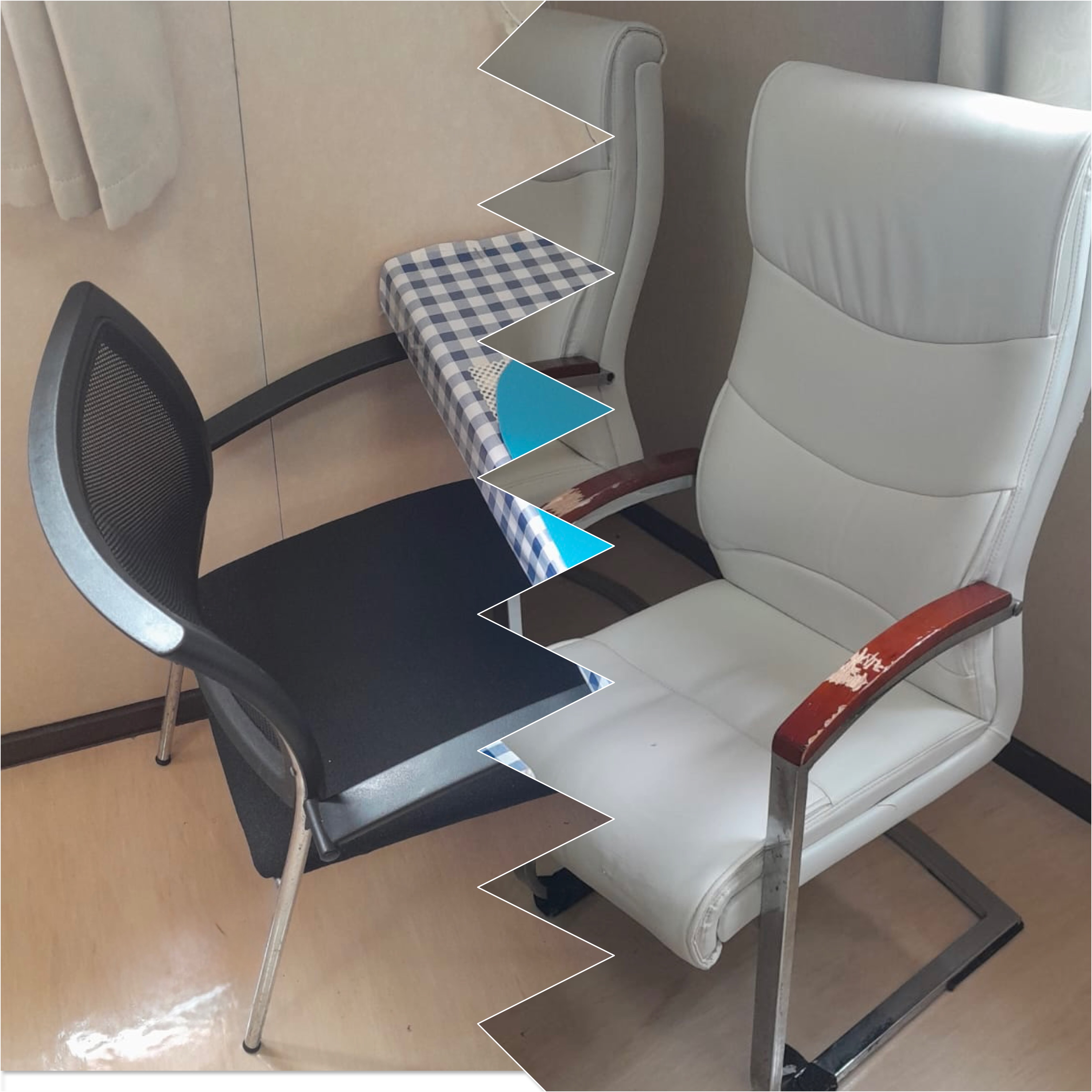
There is one mess, one dining area and one TV room. Yet there is a silent dividing line that shouts that all people on board are not equal. The stylish, soft, white upholstered chairs are for the officers' mess, with hard, rickety plastic chairs for normal seamen. The soft chairs are in front of the screen. The hard chairs are like wall flowers along the edges. Chairs arranged according to value... unambiguously also an indication of your value on board.
Let me explain. An ordinary seaman earns mostly a minimum wage, barely covering the breadline. Rand for rand the difference between a Captain's salary and that of an ordinary seaman is as far apart as the East is from the West. That is one aspect, but what is worse is that the men are often treated accordingly too. It is as if they are the dreck without any value and are simply on board to serve others.
Loffie, of course, is invited to sit on the white comfortable chairs, but he walks on. He purposefully walks to the rickety chairs and sits down next to a man that is probably not noticed very often. He asks his name and listens to his story. With empathy he shares the Word that cannot distinguish, on any level, who or what you are. In the context of the Cross, the chair you sit on remains irrelevant.
During his daily work Loffie meets the world. He meets men from the poorest parts of India and the Philippines, but also from Bangladesh, Thailand en Myanmar. Over the past years the sea also brought more men from Russia and the Ukraine - caught in the grip of war, afraid to go home. Today there is a new stream of men from Eastern Europe - all ordinary seamen from Croatia, Bulgaria ... most of them driven by need.
They sign contracts for nine months. It means nine months away from their children. Nine months without the voice of a dad, making the voice a mere memory. Poverty forces them to the seas, but it leaves a gap that can only be filled by God.
This is exactly where remarkable things happen.
Every new nationality is accompanied by another language, a new language and every new language opens the door for the Word. The love and mercy of the Man of the Cross is whispered in passages where it had never been heard before. Chinese literature is distributed. Prayers are mouthed silently. Hearts are opened and become receptive.
Thank you for being part of this and for your financial support. Thank you for helping us carry this silent, but deep work. Please pray for the 'ordinaries' of the seas. Pray that they will experience the bigger Truth than the chair on which you have to sit - that a chair does not make the man. Also remember Loffie and each of our Chaplains in your prayers, pray that they will continue to sit where others do not want to sit - until every man knows: He is seen and he is loved. God's love and mercy is for him too.
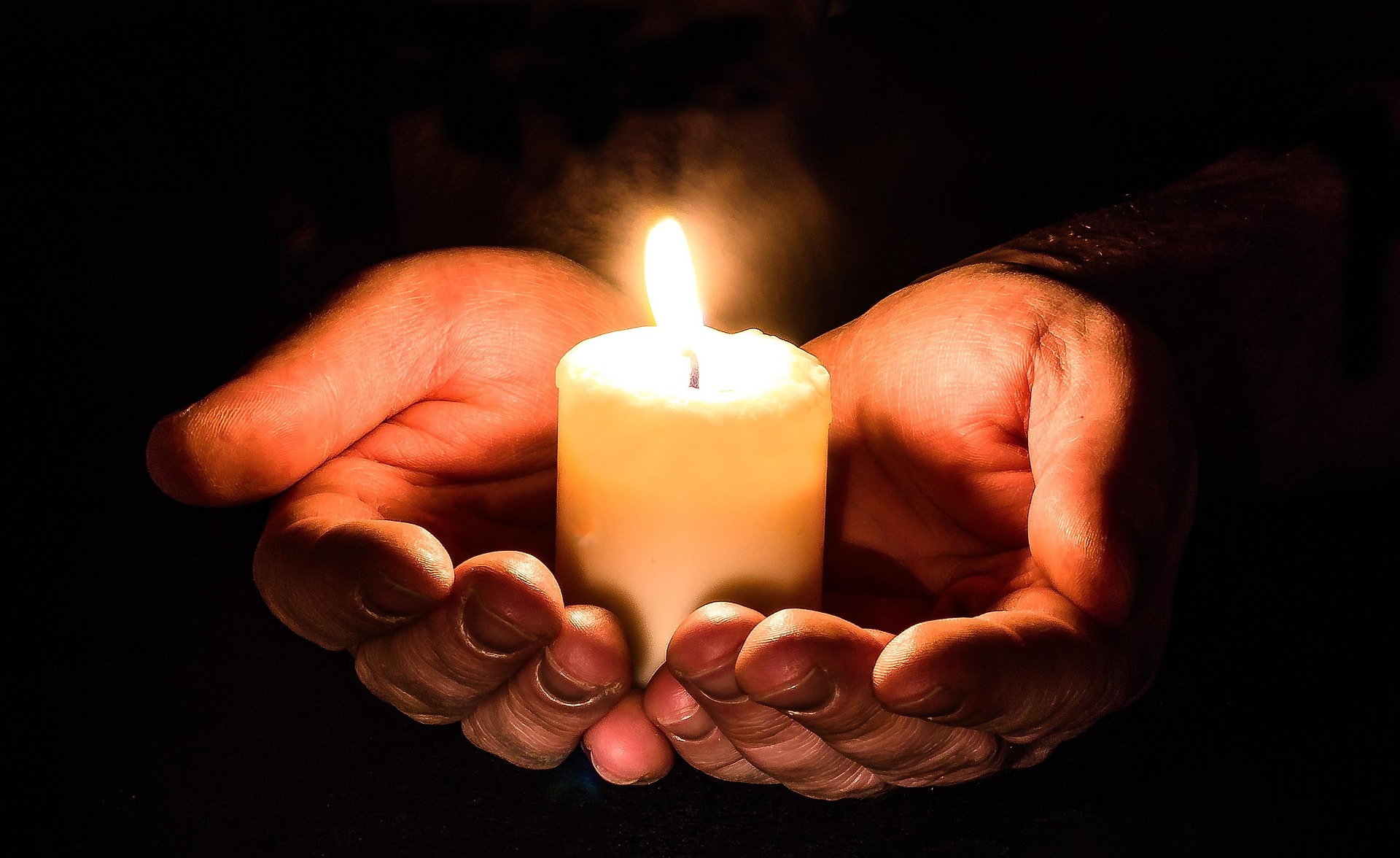
The oceans now carry more than freight. It carries tension, whispers of war and the faint thunder of insecurity that cuts even through steel and waves.
Miguel,a main chef from the Philippines stands in the kitchen. His grip is strong when he shakes your hand, but his eyes have a far-off view - secretly he is looking beyond the ship, beyond the horizon, he is looking home where his wife and children are waiting. The radio talks about attacks around Iran, of ships sailing a route without economic viability, rather on risk. In his hand he holds a CSO Bible in his own language. It is not only paper - it is an anchor. As the world around him shouts louder and louder, he reads with Danie, about tenderness and love that remains soft. He holds it like someone that understands how fragile everything is.
At the next ship, a young engineer from India remains seated after the meal. He is alone at the table. The plates have been removed, but the tension remains. Every shifting the engine room now feels closer to danger. Every change in direction leads to an urgent question - shall we be safe? He picks up a Bible, seemingly insecure whether it is allowed of not. When he talks to Danie it is soft, insecure. And yet, when he finally walks away, he is holding the Bible close to his chest. It explains his gratitude for the moment of peace that he found at that table.
On another deck, Oleksandr from the Ukraine is standing, staring at the mist hanging ominously over the harbour this morning. His own country has been broken by war already and now the shadows are following him across the seas. The Middle East is on fire and even here, far from everything, he clearly feels the glow of the fire. He is holding a Bible, not with big words or prayers. He is only holding it - like someone needing to find the light, without knowing where it will come from.
As Danie visits ship after ship, the mist does not lift dramatically. The world does not change suddenly. But, here something else is definitely happening. Hands are extended without agenda. Bibles are being opened like windows. Here, the love of Christ is spread, not with loud noise, only spread in small, quiet deeds.
The world is dividing, but here connections are found. Where war brings about fear, here you find empathy and softness. It is not because the sea is calm, only because the Living Hope helps to throw out anchor. For a moment, a mere moment, there is the solid knowledge that this Light is stronger than the dark.
Thank you so much to our friends and donors for making this happen. It helps to shine the Light. The Light helps in a world that needs it so very urgently.